The Process of Re-Authoring
Therapeutic Reflection
The Altered Book intervention serves as a powerful medium for externalizing internal narratives. By using preexisting media, the client is not faced with the "anxiety of the blank page," but rather an existing structure they can deconstruct and rebuild a story.
Theoretical Application
Symbolic Transformation: The transition from the original media to the altered state mirrors the psychodynamic goal of bringing subconscious fears into conscious creative control.
Narrative Agency: For adolescents and adults, the act of physically concealing or revealing words and images enables a tangible "re-authoring" of their own experiences.
Containment: The use of a book or journal provides a physical container for "unpleasant feelings," allowing the client to safely acknowledge traumatic or difficult material while maintaining creative distance.
Clinical Considerations
Material Diversity & Inclusivity: It is essential to provide a wide range of preexisting publications and media that reflect diverse cultural backgrounds, identities, and values. This prevents the glorification of narrow mainstream standards and ensures all clients feel represented within their symbolic narratives.
Cognitive Readiness: This intervention is specifically suited for populations capable of abstract thought and symbolic analysis, typically adolescents and adults.
Trauma Awareness: While the process allows for re-authoring difficult narratives, it may be contraindicated or highly challenging for individuals currently experiencing acute traumatic symptoms.
Specific Population Adaptations: Eating-Disordered Populations: Avoid media depicting the human form or food, as these may trigger unhealthy thoughts or body-image distress. Addiction Recovery: Be mindful of imagery containing alcohol or specific "atmospheres" that may serve as unique triggers for the client.
Artist Statement(s)
“The Process of Re-Authoring”
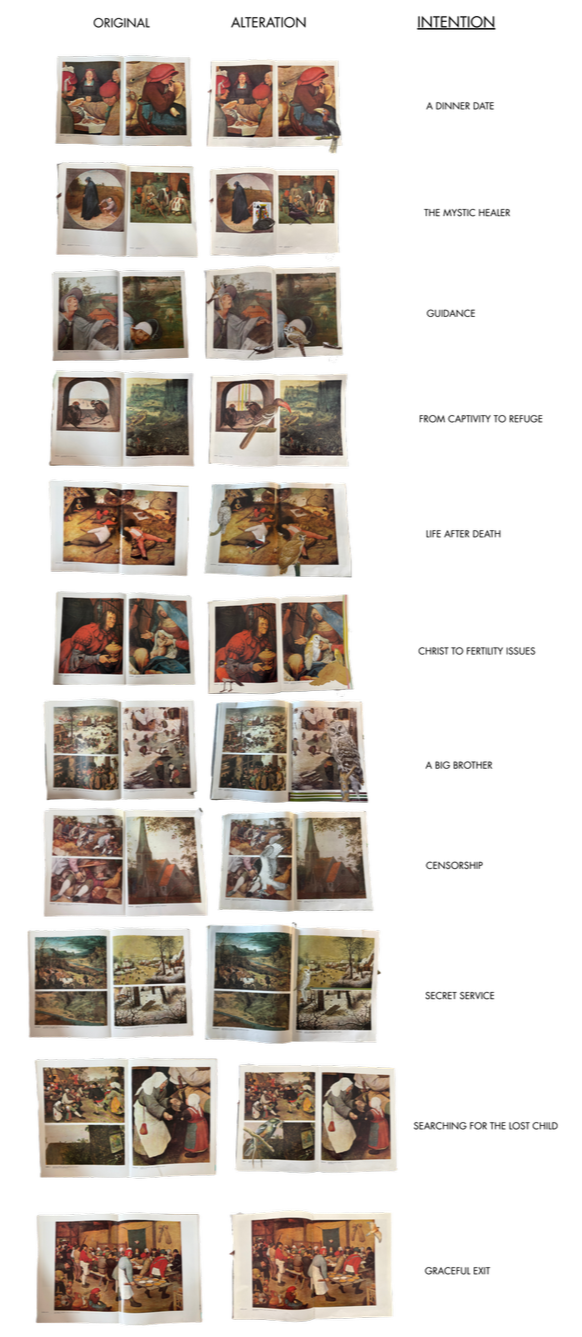
In this intervention, the book is no longer a static object in someone else's story, but a landscape for personal discovery. This process began with selecting media that resonated with a specific memory or belief. By analyzing symbols and identifying figures, I moved from a passive observer of the artwork to an active creator.
By overlapping images, weaving concepts, and physically altering the page. I was able to conceal the unpleasant imagery and ideas on the page with new solutions. The resulting "altered storyline" is a way to reframe personal history and give it new meaning.